Thursday, May 16, 2013

Texas project featured in the Waco Tribune-Herald

Blank wall awaits Waco artists’ visual poetry
from the Waco Tribune-Herald
May 16, 2013
By Carl Hoover
choover@wacotrib.com 
 
How do you sum up a community in a mural?
Is it more than a sum of history and well-known personalities? Is there more than one dream that speaks to its residents? How does an artist translate a city, a town, a neighborhood into a two-dimensional image? Kansas artist and muralist David Loewenstein suggests writers face the same challenge and solve it the same way: poetry. Visual poetry, that is. “I like to think of it as a visual poem that refers to the dialogue with the people we’ve worked with. It’s more symbolic than a literal timeline. . . Ours is more geared toward a feeling, a resonance, a process,” he said. Loewenstein, assistant artist Ashley Laird and Texas apprentice Catherine Hart hope to turn local comments, suggestions and discussion into a Waco poem on the southwest side of the East Waco Library.

Mural Project
The three are in Waco for the next two months as part of a six-state Community Mural Project underwritten by the regional arts agency, the Mid-America Arts Alliance. Waco joins Tonkawa, Okla., Arkadelphia, Ark., Joplin, Mo., and Newton, Kan. Organizers are presently evaluating proposals for a mural in Nebraska to complete the project. Loewenstein is a Kansas artist with a strong background in murals, although they’re far from his only art as he’s also a printmaker and writer. He’s joined by Laird, another Kansas muralist, as his assistant. Austin artist Hart rounds out the team as a mural-painting apprentice. Hart got bit by the mural bug after painting on one. “I realized going really large was invigorating,” she said.

Community ideas
Three community meetings at the East Waco Library this month have provided the artists with ideas, though the muralist notes that it sometimes takes awhile for people to get beyond wanting to honor specific individuals and historic events. The muralists are trying to nudge contributors beyond the usual suspects of the Waco Suspension Bridge, longhorn cattle and the Chisholm Trail. “That’s OK, but there’s not as much poetry in that,” he said. Experience with other community murals tells the artists they’ll have plenty of ideas to pick and blend together. “We can’t fit in most suggestions we get. There are too many and folks want everything in,” he said. “It’s hard to edit down.”

Community murals often have a different language and style than commercial ones because their purpose and process are different. Most large outdoor art, seen on billboards and walls, is meant to sell products or candidates, he noted. In addition, the public usually sees visual art as an individual creation and not collaborative as, say, theater or dance, he said. It’s the project’s discussion phase in the community that can build something more than art, namely civic conversation and communication. In Arkadelphia, mural meetings brought out a discussion of the city’s past racial discrimination. Joplin, devastated by a tornado just before its mural project began, saw a small controversy over how dominant the tornado and its impact would be in the mural design — if included at all.

Part of the process involves showing what’s possible in a mural. Oversized, simplified images often work better than small, detailed ones and bright colors do much to attract the eye, although the Kansas muralist adds part of that is his own artistic sensibility. “We look at other murals because you need that vocabulary to do what you want it to do. You have to understand what’s been done and what’s possible,” he said. A look at Loewenstein’s own mural designs reveal small touches that increase viewer impact: subtle geometric forms and lines that direct the viewer’s eye, imply motion and unify elements. Balancing what’s in a story and how to tell it is Loewenstein’s artistic sweet spot: “I’m smack in the middle between story and technique,” he said.

After the community meetings, the artists draft a design team from those willing to work on the mural’s look and painting. That team’s input helps shape the design that Loewenstein and his associates craft, then fine tune. Once the design is approved by the team and the city, its outline will be projected and painted on the library wall. The community will pitch in to paint the first weekend, with as many as one hundred people getting involved, Laird said. After that, the artistic team will take over, handling any detail work and final touch-ups. The Waco mural should be finished by mid-June. Given the special exterior paint used, its images should last more than a decade before any touch-ups are needed.

It won’t be just art left behind but friendships and relationships when the muralists move on after the project’s completion, said Loewenstein, who said sometimes it’s hard to say goodbye to a community that has pulled together to create art. “It’s heartbreaking to leave places that are alive with wonderful people,” he said.

Wednesday, May 15, 2013

The Waco Mural Team

In East Waco, I am joined by an experienced and talented crew. 


Mural Assistant Ashley Laird
Ashley is a muralist and studio artist based in Lawrence, Kansas. She is a veteran of the Mid-America Mural Project having assisted on both the Joplin and Arkadelphia murals. After graduating from Washburn University with a BFA in 2011, Laird has worked on numerous public projects including the Mid-America Mural Project, the 2nd Annual Welling Court Mural Project in Queens, NY, and just returned from Songdo, South Korea where she assisted with a collaborative mural in the city's Central Park titled "Songdo: A City on the Rise." In Topeka, Ashley was lead artist for the latest mural on the Great Mural Wall titled “Reanimating the Arts in Topeka.” Laird’s latest studio work culminated in a solo exhibition, “Turning Back The C(l)ock,” at the Bourgeois Pig in Lawrence, KS, one of the drawings of which was showcased in the exhibition, Backlash! at the Soho20 Gallery in New York City. In March of 2013, Laird spoke about these drawing at the Southern Graphics Conference in Milwaukee. In 2012, Ashley led women and children in a collaborative painting project for Survivor Art Night at the Topeka YWCA Center for Safety and Empowerment for which she was honored with the 2012 Arts Advocate Award. Ashley is one of the founders of Chords and Oil art collective in Topeka, KS, a springboard organization for many unique projects from 2009-2010 including a major installation at the city’s public transit hub. Her future projects include mural commissions in South Dakota and Nebraska. Ashley's blog is http://ashleyjanelaird.wordpress.com/


Mural Apprentice Catherine Hart
Catherine has been a maker for as long as she can remember. After years of playing with markers, paper, and clay, she took her first art classes at the age of ten. She began attending an art camp during her summers where she discovered her love of blowing glass. In high school she continued to paint, draw, and blow glass by commuting to a studio in Brooklyn, NY from her hometown of Montclair, NJ. She received her BA from California College of the Arts in 2004. Hart then moved to Austin, TX in 2005 where she ran the local art supply store Jerry's Artarama, expanding her knowledge of all art making materials.  She was the 2011 Artist in Residence at the East Side Glass Studio in Austin,
where she completed her first mural & found a new excitement for large scale work.
You can see more of Catherine's work at https://catherine-hart.squarespace.com/  
                                                
                                                  
Project Coordinator  
Doreen Ravenscroft
Originally from near Chester, England Doreen graduated with an S2 degree in Chemistry from Carlett Park Technical College in Eastham, England in 1962 and was employed thereafter by Unilever in England. In 1976 she moved to the United States with husband William (Bill) Ravenscroft. In 1979 they moved to Waco. Doreen has served on the boards of: Art Center Waco, Waco Women's Symphony Guild, Historic Waco Fort House, Waco Independent School District Foundation, AJ Moore Advisory Board and Community Race Relations Coalition committees. In 1997- 2003 she co-chaired the Open Door Arts Fest, a visual and performing arts festival. She has received many awards including: the 2001 American Fundraising Professionals Volunteer Award of the Year, the 2006 Zambelli Internationale Volunteer of the Year award by the International Festival and Events Association, the 2007 Make a Difference award for the arts in Waco and the Waco Foundation 2011 Ruth and Lawrence McMillan award recognizing visual public art. In 2004 Doreen founded the non-profit organization Waco Cultural Arts Fest, dba Cultural Arts of Waco of which she continues as the president and producer.

Tuesday, May 14, 2013

Getting oriented in East Waco

The Brazos River divides East Waco from downtown as long as you don't consult a compass. That's because East Waco is really north of downtown and maybe sort of a little bit east.  To know your way around Waco, you have to spend time here - no map or GPS will do.


We're staying just a few steps away from the river in an area that used to be the heart of the African - American business district (and before that home to the Waco tribe), but was razed in the late 60's as part of an urban renewal effort. And you can tell there's something missing. The empty lots that lead up to the river beg the question, what was here?


Crossing over the elegant pedestrian suspension bridge that connects downtown to the eastside feels like going back in time. From the upscale Hilton and Indigo hotels over to the Empire Seed Co. selling bedding plants and flower bulbs along the remnants of Bridge Street. Elm Avenue known to everyone as Elm Street begins at the east end of the bridge where one of the old bridge supports is painted with a mural about the life of Martin Luther King Jr.


This felt like a good sign and there are other murals that dot the streetscape along Elm, although many of the buildings appear vacant and need of serious restoration. A few like Lula Jane's signal a possible future - a different kind of renewal that draws in students from Baylor University for tasty baked goods and lattes.

Lula Jane's

The site for our mural is the east branch of the Waco Public Library in a a building that used to be an HEB grocery store. That transition from grocery store to library is compelling and has got me thinking - from food for the body to food for the mind. Ironically, now there is no grocery store in East Waco making a large part of the area an urban food desert. Another story of transition in the neighborhood is underway just across Elm from the library where the Paul Quinn campus, home to an Historic Black College that moved to Dallas in 1990, has become a successful charter school called Rapoport Academy.

 
Named for Audre and Bernard Rapoport and founded by educator Nancy Grayson (who has turned her attention to baking at her latest endeavor Lula Jane's), this expanding new school is helping to reinvigorate the neighborhood.

Ashley, Catherine and I have just begun to explore and meet with neighbors. But judging from our first week, we expect a dynamic series of design team sessions in the coming weeks.


Monday, May 6, 2013

Monday, April 1, 2013

Texas mural site selected

We are excited to announce that Waco, Texas has been selected as the next site for the Mid-America Mural Project! Beginning in May, lead muralist Dave Loewenstein, assistant Ashley Laird and apprentice Catherine Hart will begin working with with local residents to envision their mural. Check back here for more details soon.


Wednesday, February 6, 2013

The art of Sammy Landers


There is one more story (and one more mural) to share about our project in Arkadelphia. Early during our visit there, while we were still trying to untangle the mysteries of what kudzu covered beasts lurked behind our temporary home, and the many shaded meanings embodied in the common phrase ‘bless your heart,’ we were introduced to the remarkable artwork of Sammy Landers.  Jane Lucas, Executive Director of Group Living Inc., took us on a tour of Landers' work displayed downtown, including a quick stop to meet the artist himself and a peek at an archive of his drawings from the last twenty years. 


Sammy, who has autism, has been a client at Group Living and the Arkadelphia Human Development Center for most of his life. He doesn't like to talk much so Mariela Crockett, who works with Sammy, was kind enough to share some of his background. She said that Sammy came to Arkadelphia as a teenager from his home in Hughes, Arkansas. While he still had family there, Sammy would make periodic visits home, returning with incredible drawings that people started to take notice of.

In the early 1980’s, when he came to live in Arkadelphia permanently, the output of his drawings grew greatly while the subjects he chose to depict evolved. Responding to his passion for drawing, folks at Group Living made a studio space for Sammy above their Bee Hive thrift store. Mariela said that his early work was influenced by food can labels, jigsaw puzzles and magazines donated to the thrift store, and that it developed over time to reflect the people and places in his life. 

Landers’ best-known works are instantly recognizable, boldly stylized, and beautifully colored drawings that defy easy categorization. Often depicting pairs of fantastic figures with symmetrical features and elaborate outfits, they look at once like cousins to Transformers and iconic figures from an unknown ancient culture. After a 1997 tornado partially destroyed the apartment he was living in, the figures pretty much disappeared and he became focused on highly detailed renderings of buildings. 

Made on common sketch-pad paper, his drawings are tightly rendered using drafting tools, colored with carefully applied layers of crayon and then scrapped through to create deep and luminous textures. Viewing dozens of Sammy’s drawings laid out next to each other in the Group Living offices, I started to see the many characters as the cast of a grand costume drama, maybe a fable, where a young boy and girl encounter a series of trials along an epic journey. 


I was inspired by Sammy’s work and I wondered how we might shine a light on it for the broader community to enjoy. During our stay, I talked with Jane and Mariela about how to do this. Sammy had had exhibitions and many people owned his drawings, but there were many more who were unaware of his art. What if we were to reproduce one of his drawings as a small mural outside of his studio on Main Street, I asked. Would he like that? Yes! he would be thrilled, they said. 

It was difficult to decide which drawing to recreate. There were hundreds of options, including his characteristic figures, buildings, and even a few landscapes with ‘okra trees’ as they’ve come to be known. In the end, we chose a drawing hanging in the Group Living offices that showed a family of four figures as opposed to his usual pairs, including one with an umbrella that people have come to refer to as Sammy’s Mary Poppins. This drawing also had an uncharacteristically well-developed background made from an interlaced pattern of colored shapes – perfect for a mural.


As the outline of the mural started to go up, we asked Sammy to come out and have a look. He recognized it immediately as his work and said emphatically “ Keep it there.”  That sounded like a pretty clear approval so we went into overdrive to finish it in the day and a half we had left in town. 


Long story short, Arkadelphia has two new murals, one a community-wide project and the other, just down the street, in appreciation of the great Sammy Landers.


Thursday, December 27, 2012

New mural projects in Texas and Nebraska in 2013

The Mid-America Mural Project will be going to Texas (spring) and Nebraska (late summer) in 2013! Any community within those states is eligible to apply. In addition, each project will hire a mural apprentice. Links to the RFP's and apprentice applications are below.

Texas Mural Project RFP
http://www.arts.texas.gov/jobs-opportunities/rfp-texas-community-mural-project/

Texas Mural Apprentice Application
http://www.arts.texas.gov/jobs-opportunities/temporary-position-mural-apprentice/

Nebraska Mural Project RFP and Apprentice Application
http://www.nebraskaartscouncil.org/public_art/nebraska_mural_project.html

Tuesday, November 6, 2012

Arkadelphia mural postcards available

Beautiful 4" x 9" inch postcards of From a Dream to The Promise are now available. They are .50 each plus shipping. Email me at  dloewenstein(at)hotmail.com  to place your order.

postcard frontside

postcard backside

Monday, October 22, 2012

Arkadelphia's completed mural - "From a Dream to The Promise"

From a Dream to The Promise


Lead Artist - Dave Loewenstein
Assistant -    Ashley Jane Laird
Apprentice - Jordan Karpe

With the help of over two-hundred community volunteers.

Supported by:
Mid-America Arts Alliance
National Endowment for the Arts
Clark County Arts and Humanities Council
Caddo River Art Guild
Group Living Inc.

The mural is 24 feet tall and 65 feet long painted on the west facing wall of the Honeycomb Restaurant at 705 Main Street.

Scroll down to read a description of the imagery in the mural.

The main theme for our mural is Education. Within that theme, we have been guided by the phrase, “The journey from a dream to the promise.” The architecture of the composition is built from the combined ideas of an Arch, a Bridge, and a Porch / Stage.

Framing the Arch at the upper left and right are soaring pine trees reaching up to the sky with a Cockaded Woodpecker on the left (an endangered species protected by the Ross Foundation) and a majestic Blue Heron on the right commonly seen in the area’s rivers and lakes.


At the base of the arch is a series of panels that from left to right represent:
1) The heart of a pine tree, revealing its history and symbolizing ours
3) Honeycomb as a reference to the Group Living restaurant where the mural is painted
4) A Beehive as another reference to Group Living
5) Caddo pottery decoration
6) The Salt Kettle in front of the courthouse and a molecular diagram of salt

Within the Arch is a tableau that celebrates Arkadelphia’s leadership in education. Beginning at the far left, a young man sits on the porch holding a pine tree seedling (symbolizing his potential) while gazing into his uncertain future and toward aspirations of Ouachita & Henderson universities, and early educational leaders Julius Rosenwald and Booker T. Washington, who set the ground work for Peake School and thousands of others like it in the 1920’s and 30’s. Above and to his right, is a quote from a poem by the Arkadelphia writer and humanitarian John Allen Adams which reads "I walk toward the sound of my days."

Beyond those aspirations, the young man looks towards a dynamic allegorical figure, with a dress embellished with keys to unlock ones potential and dreams. She symbolizes the many past and present mentors and teachers who have helped guide Arkadelphia’s young people. As she is conjured up and made real by a fashion designer, inspired by Arkadelphia native Martha Dixon, and her apprentice on the steps, the symbolic mentor extends her hand as an invitation to the young man and gestures toward Arkadelphia’s Promise, which is illuminated under the lantern she carries. 

The kick-off ceremony for The Promise at Arkadelphia High School, accompanied by fireworks and music, completes the educational dream of the young man who we see again at the far right. In one hand he carries his diploma and with the other he passes along the symbolic pine seedling to a new student who will soon begin her own journey.

This story is enhanced with specific references to Arkadelphia and Clark County.  Along the length of the porch are references to important institutions and architecture including Caddo dwellings, Hill’s Café, Peake School, a church, the public library, and the high school stadium. 

At center left, a fiddle player sits on the porch and plays the folk tune that is the story of the mural. His music resonates throughout and reminds us that we need to actively maintain a community of giving teachers and mentors who can lead the way for Arkadelphia’s young people. 

At the center right, we see a group from our mural design team engaged in the process that has led us here. They / we  have given our time to do what the fiddle player symbolizes –  telling the story of this community’s commitment to giving each person the tools and resources they need to be able to reach their full potential.

In the center above and behind the figure for education, is an iconic view of the Ouachita River from the Bluff. Looking out from its edge are the explorers Hunter and Dunbar who were among the first people to map this region. In the background just below the Bluff, the rings of a giant tree (inspired by the Ross Foundation’s remarkable lobby) connect the story from dream to promise. 
To the right and left of the Bluff, are panels with decorations inspired by designs on the old Arkadelphia High School. And at the very top center, an illuminated letter A for Arkadelphia is carried forward by doves of peace.

A sincere thank you to all who helped bring this project to life, give it form, and carry it forward.


Friday, October 19, 2012

Post from mural apprentice Jordan Karpe

The following post is from mural apprentice Jordan Karpe.

 On one of our final days here in Arkadelphia the sky was threatening rain. The clouds were growing darker, and people passing by casually mentioned imminent inundation. Not a single drop fell though, and the mural was coated in varnish marking the completion of the project. After more than three months of living in town, I spent one of my last days frantically brushing clear coat plastic onto the wall and consequently myself. The smell wasn't too agreeable, and peeling it off my skin took awhile, but there was an immense moment of relief when it was done. My mind is wrapping itself around these last few months, the experiences, the friendships, and the lessons.

I've grown incredibly fond of this community mural process. It combines a lot of things I enjoy: people, public art, history, community, and lots of wonderful free food. But really just the idea that the work I've been a part of has evoked such positive responses gives me hope. The observations I've had on a living, breathing community has been fascinating. People are fascinating. Overwhelmingly the response to the mural has been supportive. So many individuals walk by and gaze upwards, chatting with their friends. Some are even brave enough to offer a kind word of encouragement. And the circumstances that helped formulate the design brought people together, and I saw people engaging with one another.

It's people engaging, not exchanging pleasantries, not smiling politely, but having conversations that instills hope in me. But I recognize how hard that can be. Everyone interacts differently, and each person comes equipped with a differing set of personal outlooks and ideas of conduct. Naturally, that can lead to some conflicts, but those conflicts aren't necessarily bad. This project has pushed people together, and I hope members of the design team maintain that air of camaraderie once Dave, Ashley, and I leave. I hope new friendships were formed in this community and that they persist. The mural is a testament to what a diverse group of people can accomplish. I hope the artists who contributed feel inspired to further collaborate. I hope all the self-identified non-artists feel empowered to be creative. A mural doesn't require a degree, or a pedantic grasp of terminology, or an expert, just people willing to engage. Dave certainly knows the ropes. He is no slouch of a painter, but I'm continually impressed by the way he engages with people.

I wish I had more time to personally thank all the gracious friends we've made. Each person from the design team and Group Living, to Dave and Ashley has brought light to my life. I could not imagine a better first project to learn from. Though there will be more murals, I can guarantee Arkadelphia will hold a special place. But for the moment, I'm ready to head home to see my dog.
- Jordan Karpe

Tuesday, October 9, 2012

Arkadelphia Mural Celebration

It was a bit cooler than we had expected, but the rain let up, sun came out, and our mural celebration / dedication went off without a hitch. A crowd of sixty plus gathered at the base of mural to listen to the Cedar Grove Bluegrass Band before Project Coordinator Farrell Ford began the program.

The Cedar Grove Bluegrass Band.
Speakers included mayor Charles Hollingshead, mural apprentice Jordan Karpe, Group Living Executive Director Jane Lucas, design team members Mariela and Natalie Crockett, mural assistant Ashley Jane Laird, and then yours truly.
Ashley Jane Laird talks about the place and people around the mural site.
Dave giving his remarks.
Sam Blackmon and Jordan Karpe.
An explanation was in order, since many were asking whether the mural was finished. The answer no, not yet. I like to schedule the mural celebration a week or so before the mural is finished. Why? Because I like the mural team to have uninterrupted time at the end of the project to finish things up and do the detailed work without worrying about speeches and such. After all the talking, it was time to enjoy home baked cookies and lemonade while the band played on.


The mural with about a week left before completion.

Friday, October 5, 2012

Arkadelphia Mural Celebration

Join us for a ....
Celebration of the new 
Arkadelphia Community Mural
Sunday, October 7th
2:00 - 4:00 pm
705 Main Street
Arkadelphia, Arkansas

TV story about the Arkadelphia mural project

KARK Channel 4 News story on the Arkadelphia mural.

http://arkansasmatters.com/fulltext?nxd_id=593132

Wednesday, September 26, 2012

Arkadelphia - painting begins

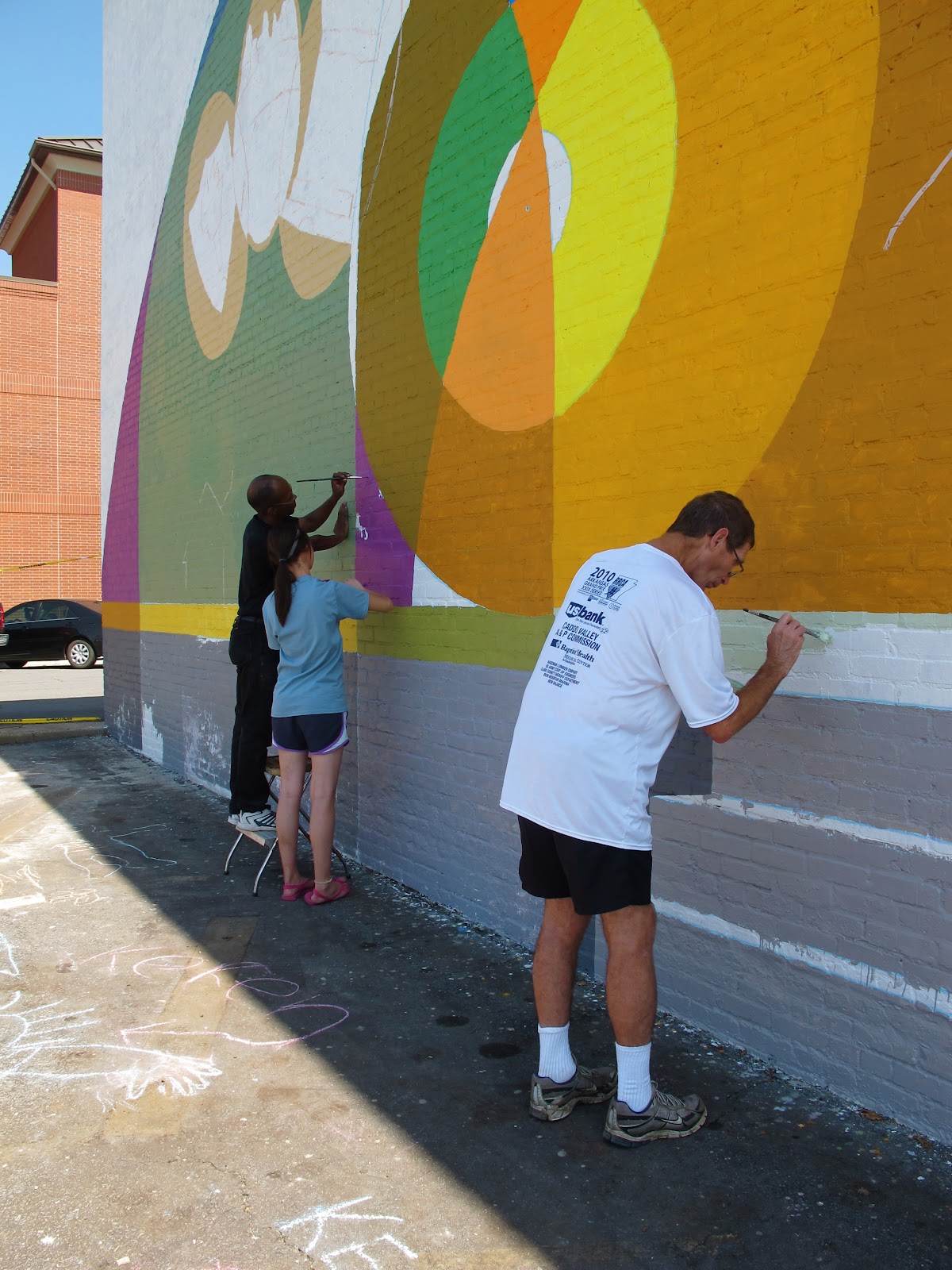
After five intensive weeks of research and design, Arkadelphians began painting their new mural on Main Street. It was overcast with intermittent rain, but that didn't keep folks away.

There is something transformative about lending a hand to a civic project like this. Its scale, its seductive color, and its potential as a new embodiment of the town's spirit inspires people (many of whom hadn't heard about the project until they drove by and saw us painting) to want to say 'I helped' and be able to point to the very spot they painted.

We begin by blocking in large areas of color in the background, so the mural initially resembles an abstract painting made up of interlocking geometric shapes. Later, figures and other elements of the composition will be projected and painted in on top of the background colors. Community painting is also an opportunity for people not involved with the design process to learn about the project, talk about its subject, and visit with friends and fellow streetside critics.

I've always been interested in how this public activity seems to enable and encourage a kind of civic interaction that can be hard to come by these days. It used to be that residents of small town or neighborhood would have many opportunities to bump into each other - at the bank, post office, and library to name a few. But with the advent of new computer technology, we no longer need to go to these places, we can do all our errands from home - alone.


So a big mural like this presents a forum and point of reference for striking up a conversation about the weather, the economy, the government and what it all means. By making it look fun, ala Tom Sawyer, we also get a lot of people to paint and thereby make their mark into their community's unfolding story.
Original sketch by Norman Rockwell of Tom Sawyer
 laughing while others do the painting.